Sylvester’s microphone
Ma Rainey's Black BottomSylvester’s microphone is the recording equipment Ma Rainey demands for Sylvester Brown after others argue that his stutter makes him unsuitable for the spoken introduction. Its arrival lets him attempt the part he was promised, but a chewed cord later becomes entangled with a failed recording and the session’s unraveling. The microphone matters not only as a tool for capturing a voice: its setup exposes who can decide whose voice is recorded, while its apparent failure shows how dependent that decision is on the equipment and people controlling the session.
Identity and Placement
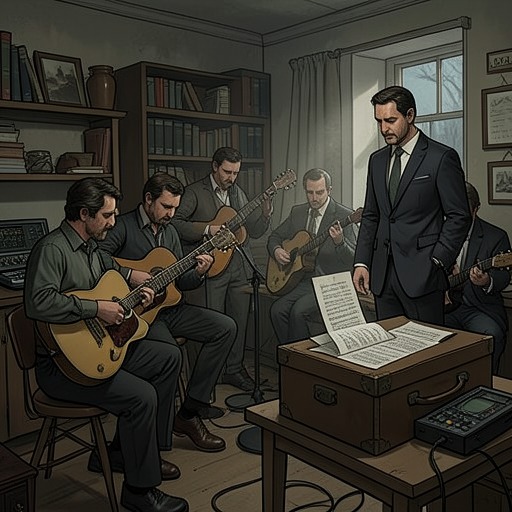
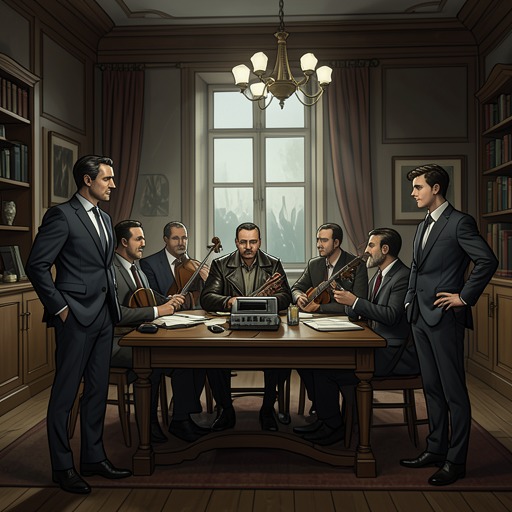
The microphone belongs to the recording session staged between two connected spaces: the basement band room, with its piano, benches, lockers, and forgotten paraphernalia, and the upstairs studio, arranged as a late-1920s recording room. Performers work in the studio while a small control booth sits at the rear, reached by a spiral staircase. A horn carries communication between the booth and the performers, and a rear door connects the studio to the band room. The microphone therefore occupies a working boundary: it is positioned for a performer, but its use is overseen from a separate room.
That arrangement is already visible when Irvin enters carrying a microphone, connects it, and tests it while Sturdyvant watches from the control booth with headphones on. Later, when Ma asks where Sylvester’s microphone is, she makes clear that the existing recording setup is not enough; a microphone must be provided specifically so he can do his part. Irvin goes to fetch one, hooks it up, and returns to the booth. The stage action gives the object a concrete route from demand to setup, while the booth and its speaker keep technical oversight at a remove from the performer.
A Voice Ma Insists On Recording
The request becomes a dispute over whether Sylvester will be heard at all. Irvin tells Ma that the musicians say Sylvester cannot do the part and that the session will have to use Levee’s version. When Irvin explains that the objection is Sylvester’s stutter, Ma rejects it as a reason to exclude him. She says she promised him the part, orders a microphone brought down, and insists that time must be made if a record is to be completed. She also threatens to leave for her tour rather than accept the session’s refusal.
Ma’s decision gives the microphone a distinct function: it is the means by which a promised contribution can be attempted despite the band’s doubts about Sylvester’s speech. Once it is connected, Ma tells Sylvester where to stand and how to hold his hands, asks him to remember the words, and reassures him that a mistake can be tried again. Cutler plays for him. After Sylvester’s first attempt, Ma tells him he has done well and should take his time. The microphone does not make the performance effortless, but the scene treats an imperfect attempt as something the recording process can accommodate rather than a reason to deny him the part.
Performance and Control
The microphone also sits within a struggle over who directs the recording. From the booth, Sturdyvant tells Ma not to wait so long before coming in and not to take so long with the introduction. Ma rebukes him: he should look after what happens upstairs while she takes care of what happens below. Her demand for Coca-Cola follows the exchange, returning attention to her conditions for continuing. The divided studio makes the disagreement physical: Sturdyvant speaks from the control room over the speaker, while Ma addresses the performers in the recording space.
This moment does not establish that Sylvester’s microphone controls the whole session, but it shows how a microphone belongs to a larger chain of decisions. The performer supplies the voice; the people in the booth listen and judge the recording; Ma insists on the arrangement under which the performance proceeds. The object’s presence makes Sylvester’s part possible, while the booth’s ability to interrupt and evaluate the take leaves the technology and its operators with their own power. Ma’s insistence on Sylvester’s opportunity and her refusal to be instructed by Sturdyvant are therefore linked within the same recording environment, without being the same dispute.
Failure and Blame
After Sylvester speaks the introduction, Irvin stops the band, and Sturdyvant changes the recording disk. Later, when Irvin proposes moving on to Moonshine Blues, Sturdyvant calls from the booth to say that something is wrong and the song has not been recorded. The exchange turns the microphone from a provision for Sylvester’s voice into a suspected point of failure. Sturdyvant singles out the boy’s microphone and tells Irvin to check it; Irvin follows the wire and says that Levee must have kicked the plug out. Levee denies doing so, and Slow Drag responds that Levee would have avoided the problem if he had been paying attention.
The inspection narrows the issue without settling who caused it. Irvin identifies the cord as chewed up and says another cord is needed. The evidence thus distinguishes the microphone itself from its damaged connection: the session initially treats the boy’s microphone as the problem, but Irvin’s check identifies the cord. Levee’s alleged action remains disputed, and the damaged condition does not by itself establish how the cord was chewed. What is clear is the consequence: Sturdyvant says the recording has not captured the song, and the group cannot simply continue as planned.
Consequences and Significance
The failed recording immediately strains the session. Ma challenges Irvin over how he and Sturdyvant could have allowed the song to go unrecorded, then calls the operation disorganized and announces that she is going home. She summons Dussie Mae and leaves to get her coat as Sturdyvant enters from the control booth and asks where she is going. The microphone’s failure is not the sole explanation for Ma’s departure, but the damaged cord and lost recording are part of the breakdown that precipitates it.
As an object in the play, Sylvester’s microphone joins access to performance with the fragility of recording. Ma can insist that the part be attempted and can resist Sturdyvant’s directions, but she cannot make a damaged cord function or recover a song the booth says was not recorded. The same device that enables Sylvester’s inclusion becomes the center of suspicion when the recording process fails. Its role makes the session’s power structure tangible: voice, authority, technical oversight, and preservation meet at the microphone, yet the equipment’s vulnerable connection can interrupt all four.